From all the textile arts, the world of embroidery has been out of my radar for the most part. Perhaps because I’ve been notoriously bad at hand-sewing, I always make way crooked lines and uneven stitches; it requires precise, mindful repetition, which is not my strong suit – I’m more of a “good enough” and “do it for fun” kinda gal.
However, I’m happy to say that recently something changed in me and I’ve grown more and more curious and interested in learning embroidery!

The first seed
My mom and I have been designing an upcycling and textile arts workshop to provide mothers (and other relevant groups) with tools for personal expression, community building, and creative entrepreneurship. During our numerous conversations about the project, she introduced me to the traditional Japanese embroidery practice known as Sashiko. It’s known for featuring geometrical grid-based patterns. They are beautifully mesmerizing and functional. The technique is often used as an up-cycling tool to mend and connect fabrics; it also adds durability and structure to them. In Japan, it’s commonly used to create home-made cleaning rags, for example. I loved the patterns, history, and the useful nature of this technique.
During other conversations with professionals in the field, who are part of this upcoming project, I was also introduced to the idea of creating a stitch book or flag, where you swatch different embroidery stitches for personal reference. After learning about it, I kept seeing this idea online, and I ended up learning there are a lot more stitches than I knew about, with lots of variations.
The reconnection
On my recent hand-made Fanny pack project, I had to do a lot of delicate, beautiful, and secure hand-sewing as well as some tricky cross-stitching embroidery on top of crochet. It was a big personal challenge, but I did do a better job than I expected. This also helped me feel inspired to continue exploring the world of embroidery. I was surprised by how relaxing and fun the hand-sewing portions of the project were!
After this new perspective with the craft, during a talk with my mom, I learned about my late grandma studies of embroidery; I knew she was a crafter seamstress for the family (and my grandfather was a leather shoemaker too) but I wasn’t aware that she also enjoyed embroidery (specifically satin/paint style) and tatting, a lacing technique – which I’ve just recently learned about.
After this talk, I found myself inspired by the possibilities. I’ve unfortunately never met my mom’s mom, but I still feel a strong connection to her. My mom says we have a lot in common, in our ways and looks, and our interests too! I feel a connection to her and other elders when I practice these techniques that are being passed down through generations of women. I feel fortunate to have access to learning techniques from a variety of experienced teachers online and in life, and to have access to the materials to experiment with them.
The beginning
I had some scrap fabric, and in a jolt of inspiration, I started cutting it and crudely sewing my book together. It’s pretty small, and since I used cotton fabric without much planning, I realized that the edges were coming apart quickly. I could’ve hemmed the edges before binding it, but without much planning, I had to come up with an alternative. The best idea I had was to stitch the sheet’s edges with a border stitch to stop it from fraying further. all around q loop. This would also be my first embroidery exercise in a sense. I started trying to do a fake overlock stitch but ended up giving up on that and doing a simple buttonhole stitch that was yielding about the same results, but it was a lot faster. I ended up finishing it up in one (long) day, a lot faster than I expected, to be honest.
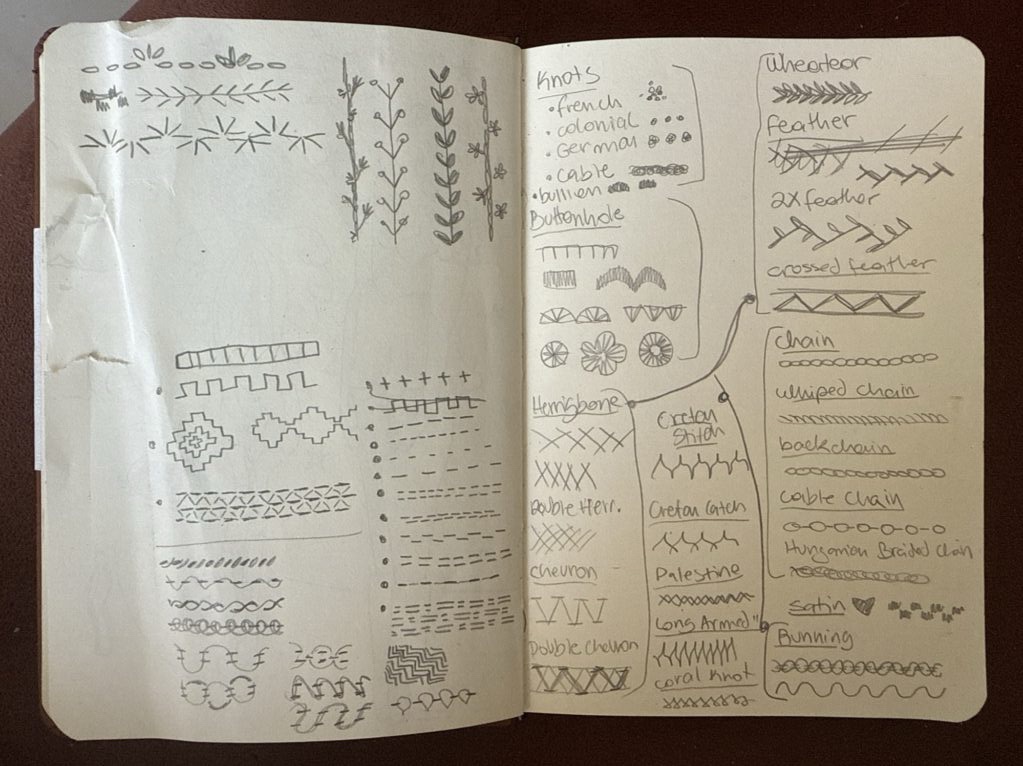
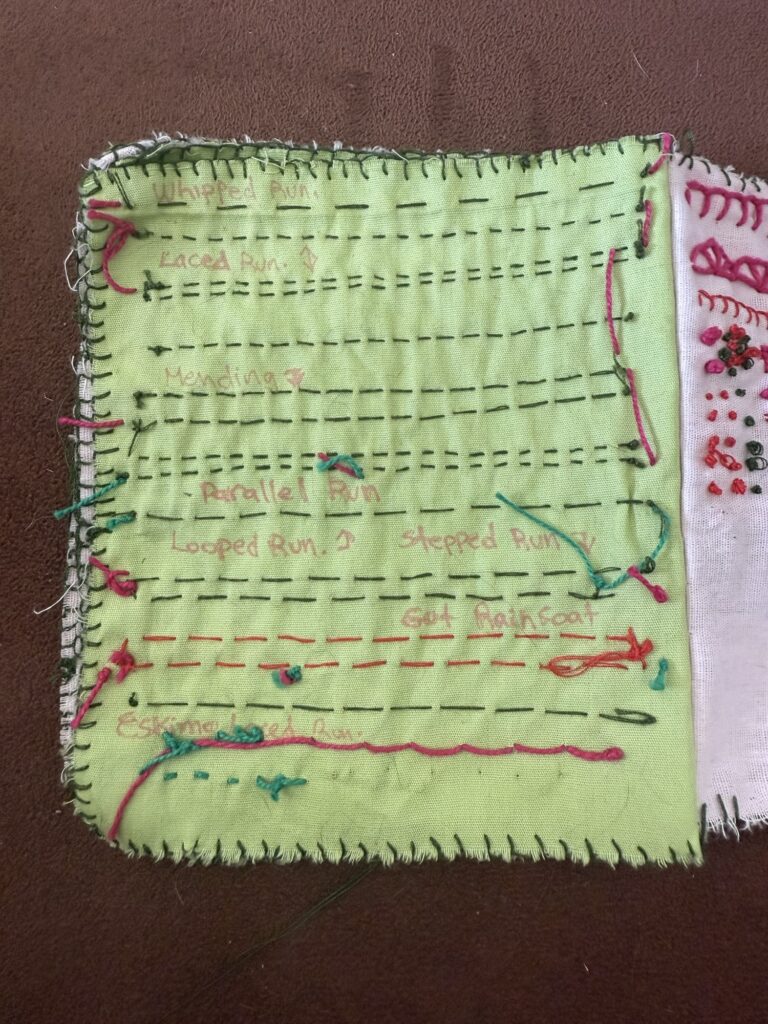
Now for the fun part: learning embroidery. I started out by planning the stitches I wanted to learn. I sketched them out in my notebook in categories I improvised along the way. I drew a few parallel lines on the first page and followed with a simple straight stitch.
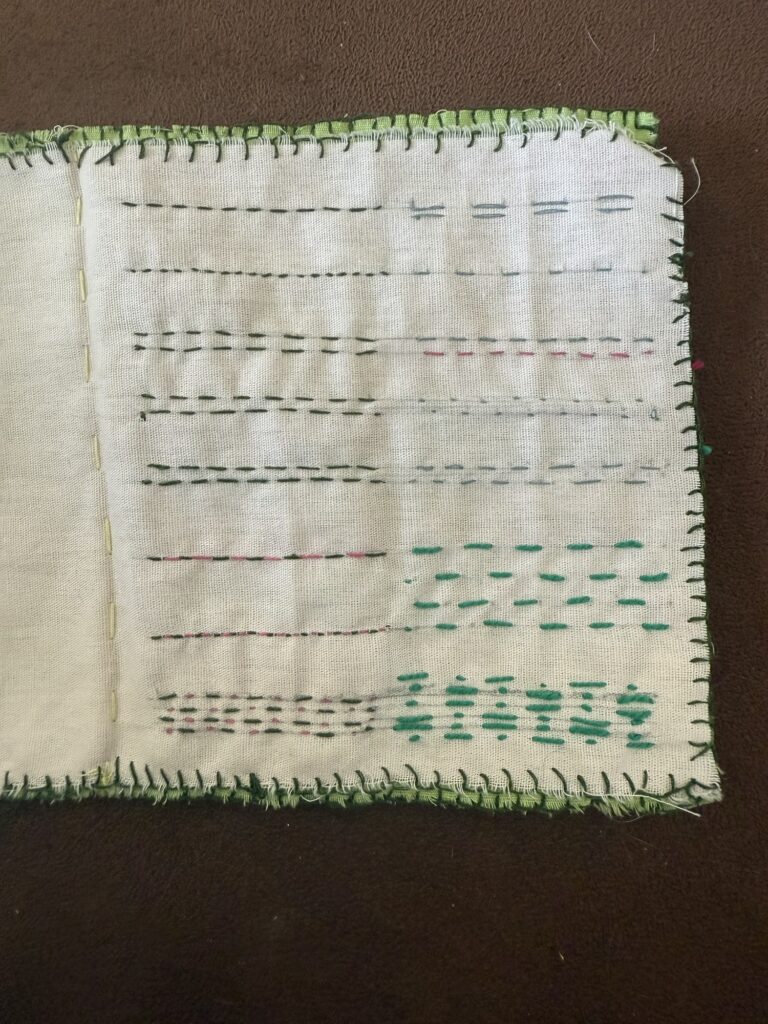
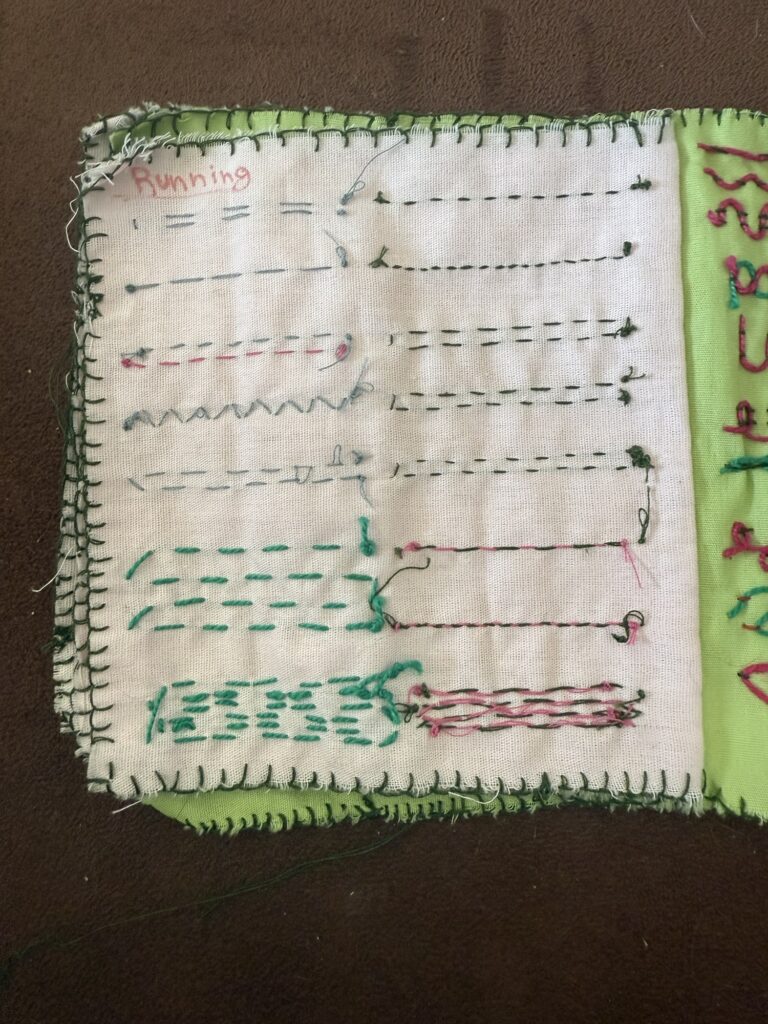
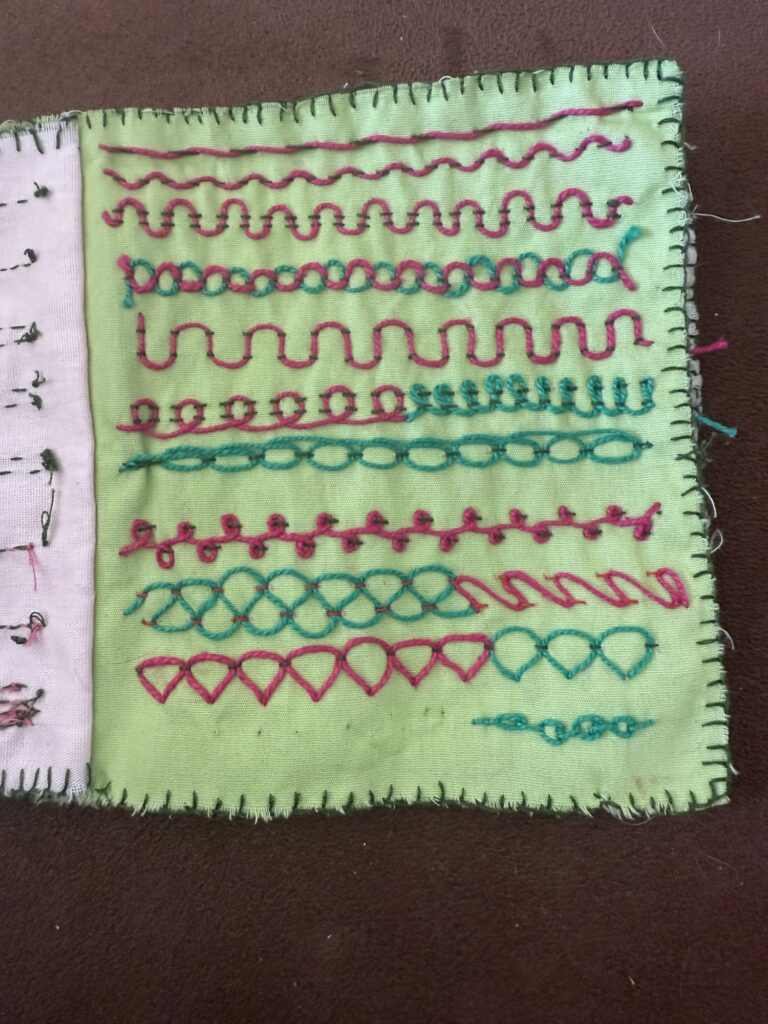
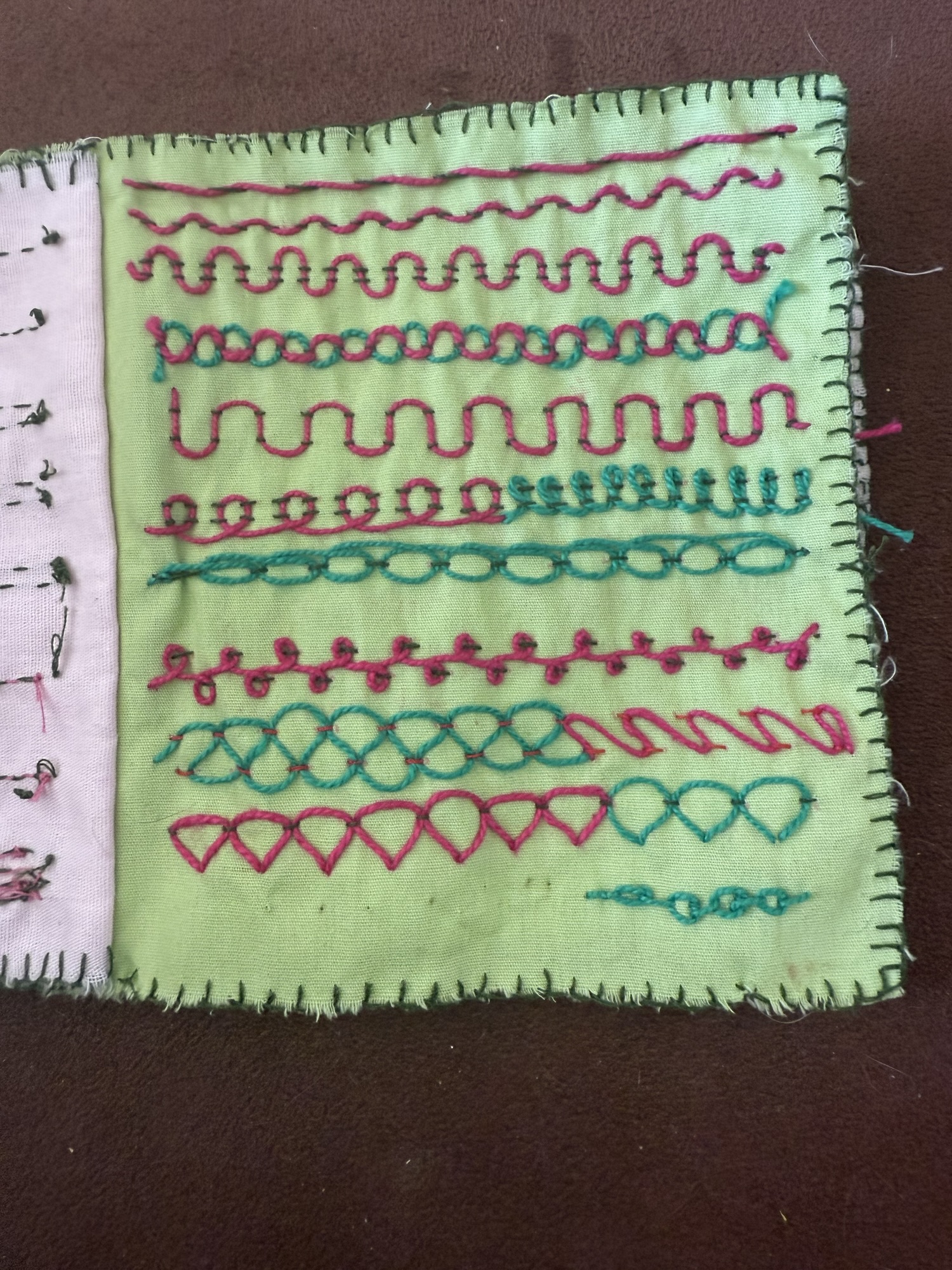
I experimented with sewing thread and embroidery thread, as well as playing with variations in stitch length, gap length, color changes, and multi-line designs. At this point, I was not sure what about my plans or if I was going to follow any kind of structure for the book, but I kept going with my explorations and learning a lot from Pinterest and TikTok. I would search up the stitch name, learn the basics, and then try to copy all the variations.
After a while, I was really learning a lot about the different techniques, and I was having fun with the contrasting colors and playing with the different variations of the same stitch. It has been a great experiment so far, and I’m starting to apply my newfound skills to more complex techniques and personal projects. I’ll post again when I make more progress on my studies with more notes about my learning and findings. Until then, happy crafting!